Recall vs Canonry
Recall measures how ChatGPT, Copilot, Perplexity, Gemini, and Google AI Overviews answer the questions your buyers ask, and keeps the evidence: the stored answer behind every number, the pages it cited, and which of the four causes of an absence applies. Then it measures whether the fix worked. Canonry is an open-source tool covering the same engines.
Recall
Measures how ChatGPT, Copilot, Perplexity, Gemini, and Google AI Overviews answer your buyers’ questions, and keeps the evidence: the stored answer behind every number and the pages it cited.
Canonry
Open-source, self-hosted agent-first AEO platform
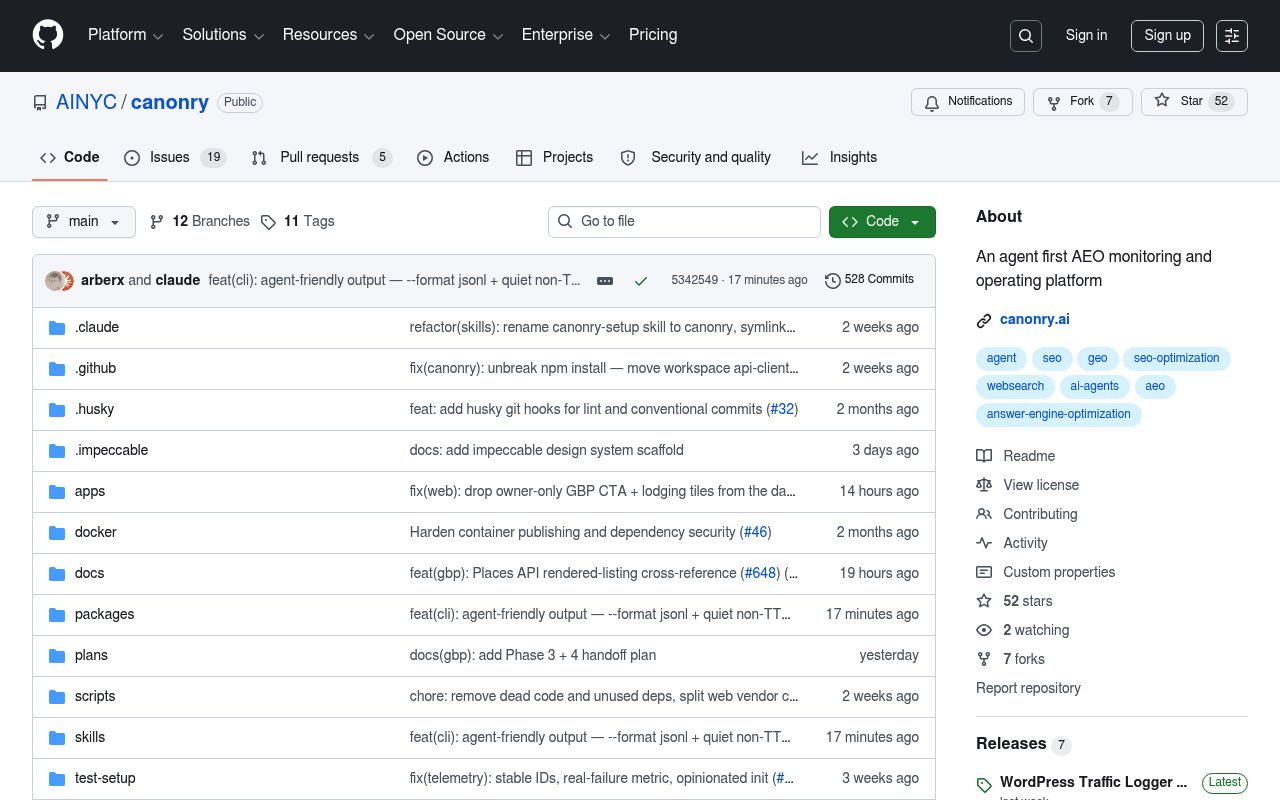
About Canonry
Canonry is an open-source, self-hosted AEO platform (FSL-1.1-ALv2 license, converting to Apache 2.0 after two years) that tracks how AI answer engines — Gemini, ChatGPT, Claude, Perplexity, and local LLMs — cite websites. It ingests server logs to measure AI-driven traffic, integrates with Google Search Console, GA4, Bing Webmaster, and Google Business Profile, and executes fixes via WordPress and JSON-LD schema. Clients are managed declaratively through YAML, and a built-in agent (Aero) exposes a 67-tool MCP adapter.
Popularity grade: D
- Open source (FSL-1.1-ALv2, converts to Apache 2.0) and fully self-hosted
- Ingests server logs (Cloud Run, Vercel, WordPress) to measure AI-driven traffic
- Built-in agent with a 67-tool MCP adapter and GSC, GA4, and Google Business Profile integrations
Feature comparison
| Feature | Recall | Canonry |
|---|---|---|
| Core Tracking | ||
| Multi-LLM Tracking | ||
| AI Visibility Score | ||
| Citation Analytics | ||
| Competitor Benchmarking | ||
| Brand Mention Tracking | ||
| Platform | ||
| White-Label / Agency | ||
| Open Source | ||
| Content Generation | ||
| Advanced Analytics | ||
| Prompt Volume Estimates | ||
| Sentiment Analysis | ||
| AI Crawler Analytics | ||
| Geographic Tracking | ||
| Social Media Tracking | ||
| Shopping Tracking | ||
| Multi-Language | ||
| Actionable Insights | ||
| Action Recommendations | ||
| Content Gap Analysis | ||
| AI Site Audits | ||
| AI Keyword Research | ||
| Reporting & Integration | ||
| Email Alerts | ||
| Data Export / API | ||
| BI Connectors | ||
Key differences
Only in Recall
- Competitor Benchmarking
- Geographic Tracking
- Multi-Language
Both offer
- Multi-LLM Tracking
- AI Visibility Score
- Citation Analytics
- Brand Mention Tracking
- White-Label / Agency
- Action Recommendations
- AI Site Audits
- Email Alerts
- Data Export / API
Only in Canonry
- Open Source
- AI Crawler Analytics
What you get with Recall
Evidence, not a black-box score
Inspect the underlying prompt, answer, citations, engine, locale, and run outcome behind each metric.
The cause, not the score
An absence has four causes and four different fixes. Every recommendation names which one it answers, so the work is chosen by the reason rather than the size of a number.
Your data stays yours
Every answer, citation, and measurement exports in full at any time. You own the record and can take it with you wherever you want to use it.
Matched before and after
Lock the prompt, engine, locale, scoring method, and sampling plan before a change ships, then report the result with its uncertainty.
/ FAQ
Frequently Asked Questions
- What is the difference between Recall and Canonry?
- Canonry is an open-source tool. Recall is an answer-engine measurement platform: it runs your questions repeatedly, stores every answer and the pages each one cited, and reports a share of answers with the confidence interval around it. Where you are missing, it names the cause — the engines cannot read your pages, cannot tell who you are, are not reading sources that mention you, or describe you in the wrong terms — because each of those has a different fix.
- What do you get with Recall that a visibility score does not give you?
- The working behind it. Every figure opens onto the answers it was computed from, with the cited pages captured at the moment they were cited. Recommendations are tied to a named cause rather than a lower score, and once you ship one, Recall re-measures the same questions and reports whether the answer actually changed — including when the result is inconclusive.
- Is Canonry open source?
- Yes, Canonry is open source, so you can read and run the code yourself. Recall is a closed-source hosted platform: what it opens up is the evidence rather than the source — every number links to the stored answer and cited pages it came from.
- Can I self-host Recall?
- Not at the moment. Recall runs as a hosted platform, with each customer's data isolated at the database level. Measuring answer engines means paying for every answer collected, which is why it ships as a service rather than something you run yourself.
Ready to track your AI visibility?
Start with the buyer questions closest to revenue or deal flow, preserve every answer and source, then measure whether the work changed the shortlist.